I Didn’t Have A Voice

11 Nov

This is a reflective piece that I wrote on August 7th, 2012, my 35th birthday. I’m finally feeling ready to share it.

There was a time during my early to mid 20s that I suffered with a recurring dream. In the dream I was chewing an oversized piece of gum. The wad of gum was so large and bulky I could barely chew it; it filled my mouth to the point that it prevented me from speaking. The gum was so painfully crammed in that I couldn’t even open my mouth wide enough to spit it out. I remember waking from those dreams with a sense of regret and remorse. What was a I doing with a piece of gum that large in my mouth and more importantly why didn’t I just simply reach in and take it out of my mouth?
….

I know a woman who recently for her 50-something birthday got the Hebrew word “voice” tattooed on the inside of her wrist, because she told me, as she held her arm up in the air showing me the dark inked-in word on her skin, “I didn’t have a voice when I was young, but I have one now.” I was left with chills. What a powerful statement.

Perhaps that’s what 35 is giving me, a voice. Perhaps, after living life a little more the lessons I’ve learned from being worn down and broken in by love have brought me the bravery I’ve needed to reach up and take that oversized piece of gum out of my mouth and really speak my heart.

(Cue Alanis song here…okay not really, but I just thought I would make the comparison before you did.)

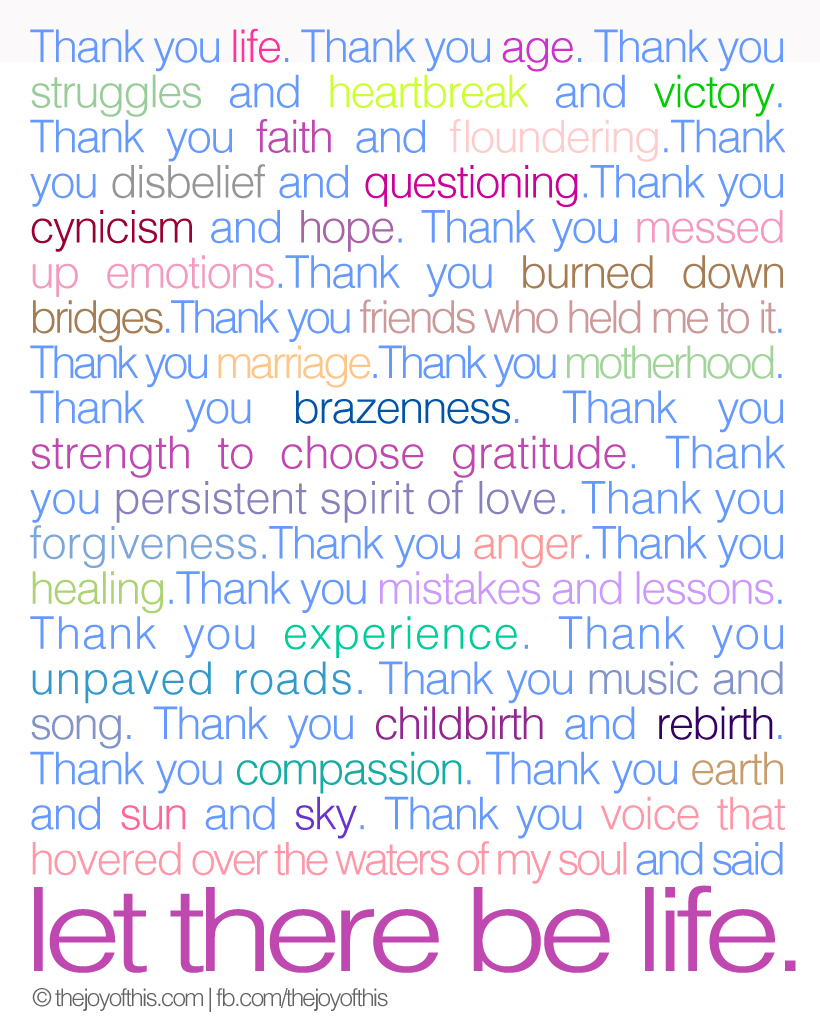
Thank you life. Thank you age. Thank you struggles and heartbreak and victory. Thank you faith and floundering. Thank you disbelief and questioning. Thank you cynicism and hope. Thank you messed up emotions. Thank you burned down bridges. Thank you friends who held me to it. Thank you marriage. Thank you motherhood. Thank you brazenness. Thank you strength to choose gratitude. Thank you persistent spirit of love. Thank you forgiveness. Thank you anger. Thank you healing. Thank you mistakes and lessons. Thank you experience. Thank you unpaved roads. Thank you music and song. Thank you childbirth and rebirth. Thank you compassion. Thank you earth and sun and sky. Thank you voice that hovered over the waters of my soul and said let there be life.

May 35 bring life and more life. May I live abundantly with hope and perseverance, may I reach up and place my hand on the harp that I hung on the Willow. May 35 be a year of getting my groove back on.

May my voice speak with love, gratitude and wisdom. Thank you 35 for giving me a voice. I hope to use it.

Facts on Postpartum Depression and My Responsibility as a Childbirth Educator

4 Nov


I attended the 2012 Lamaze Conference this year in Nashville. I gained a great deal of insight on a number of topics, but the one that won’t leave me alone was the lecture I sat in on postpartum depression taught by Genae Strong, PhD, CNM, RNC-OB, IBCLC 

Having dealt with postpartum depression with both my children, and as Lamaze certified childbirth educator, I was curious to see what would be shared. I’ll be honest, the information surrounding PPD left me unsettled.

Did you know?  

  • PPD is a potentially debilitating mood disorder usually detected between 2-6 weeks after birth. (Zauderer, 2009)
  • 10-25% of women are affected during their pregnancy or postpartum period with PPD. (Bansil et al, 2010)
  • PPD is the most under-diagnosed obstetrical complication in the United States. (Earls, 2010)
  • The mother generally doesn’t have an actual estimation of the severity of her illness.
  • “PPD is a treatable mood disorder but it is not preventable.” – Genae Strong, PhD, CNM, RNC-OB, IBCLC  (Please note, there is a difference in prevention vs. preparation.)

Higher Risk Factors for PPD include (but not limited to): 

  • Smoking
  • Bottle feeding
  • History of depression
  • A family history of PPD
  • A previous episode of PPD

What’s the difference between Maternal Blues (MB) and PPD

MB includes: 

  • 50-80% of mothers experience MB (almost every mother)
  • Appears within the first few days – 2 weeks
  • Mood swings
  • Feeling sad, anxious or overwhelmed
  • Crying spells
  • Loss of appetite
  • Trouble sleeping

PPD includes:

  • 13-20% of mothers experience PPD
  • Usually detected between 2-6 weeks after birth
  • Little interest or pleasure in doing things
  • Feeling down, depressed or hopeless
  • Disturbed sleep patterns
  • Not wanting to socialize or join in – social isolation

(Womenshealth.gov)

PPD has long-term effects on the infant, including (but not limited to):

  • Sleeping difficulties
  • Eating difficulties
  • Unusual sensory sensitivities
  • Depression
  • Social withdrawal
  • Anxiety
  • Separation distress
  • Extreme inhibition
  • Shyness

(Conroy, 2012)

As a childbirth educator I need to:

  • Teach the difference between what normal and abnormal emotional and physical responses in the postpartum period look like.
  • Encourage women who stop smoking during pregnancy to continue with their efforts.
  • Encourage breastfeeding.
  • Encourage women to attend at least one postpartum care visit with a health worker.
  • Provide handouts with local support information for mothers and families.
  • Describe treatment methods for PPD (both medical and non-medical methods) and encourage their use.
  • Carefully express the reality that PPD touches not only the mother, but the most vulnerable victim – the child.

For more resources, please visit Postpartum Progress.

To screen yourself for PPD, please visit: Postpartum Support

A Painful Childhood Memory Casts Light on My Quest As a Mother

6 Sep

Do you remember the first time you felt less than perfect? I remember it well. It was the summer between fourth and fifth grade. The apartment complex where we lived had a pool and I was there splashing around in the cool water on that blazing hot day in Oklahoma.

Another two girls were there enjoying the pool, as well. I had seen them here and there at the apartment’s playground. However these girls never spoke to me. They were tied together at the hips and seemed only interested in boys and each other. They both reeked of lofty pre-teen coolness. Their confidence matched their long, lean, and tanned frames.

I had no idea what it really meant to be jealous. All I knew was that they were not like me and that’s what made them so fascinating. They looked like sisters with their honey blond hair, green eyes, and matching black, yellow and pink suits with holes cut out in the middle showing off their flat bellies. (Nod if you remember those hideous suits from the 80s.)

I was standing on the edge of the pool, plugging my nose with my fingers, trying to work up the nerve to jump in the deep end. They were there jumping in and out like Greek Olympians. At one point they were playing just a few feet away from me. I couldn’t help it, I was blatantly and wistfully staring at them.

They ran over to their mothers, who were larger more developed cut-outs of the girls. Both moms were smeared in baby oil, reading cheap drug store novels, drinking soda and adjusting their tiny, string bikinis to avoid tan lines. How strange to have mothers who wore bikinis and read paperback books with bare-chested men pictured on the covers, I thought to myself.

I wasn’t allowed to wear a bikini and my mother would certainly never wear one, either. My mother, after all, wore long denim skirts, read the Bible and played guitar. This other version of a ‘mother’ was confusing to my 10-year-old brain.

That was the first moment I felt it – the painful awareness of being less than perfect. In a flash it washed over me, and my fascination with these girls turned into my own self-loathing.

Just then the young girls seemed to notice me staring at them. One nudged the other and walked over to me. She scrunched up her nose, puffed her stomach full of air until it rounded out just like mine. Then she lowered her chin to her chest, bowed her legs and mockingly plugged her nose. The other girl pointed her finger in my direction and through her laughter said, “Now you look just like her.” Her friend responded with, “I just need an ugly swim suit!” Squeals of laughter ensued at my expense.

That was the first moment I felt it – the painful awareness of being less than perfect. In a flash it washed over me, and my fascination with these girls turned into my own self-loathing. I looked down at my stomach, pooching out like a little melon underneath my light pink, butterfly printed suit. My short white legs were framed at the hips with the pink ruffles that were sown into the lower half of the suit.

I wanted to cry. I wanted to immediately go home and throw my suit away. This bathing suit was meant for babies. Why can’t my stomach be flat? Why can’t I get tan and tall? Why can’t I swim without plugging my nose? I held back the tears and felt humiliation creeping up through my stiffened body. I walked over to the other side of the pool and never looked their way again.

As an adult standing back surveying this childhood memory, I can see the painful value of that particular experience. I now understand the dynamics of what occurred on that summer day in Tulsa by the pool. However, as a child experiencing that moment, all I felt was inadequate and desperately hurt.

In reflection, I understand those girls were not children, not in the way that I was. My body, unlike theirs, still reflected that I was a child –  with its distended belly, chubby thighs, and flat chest. Unlike these girls, I hadn’t started puberty and I wouldn’t for at least another few years. I had no idea what puberty even was.

Today, as a mother of a daughter, I look back at that memory and ask what it can teach me. What sits inside those recollections that will help me empower my own daughter with the tools she needs to thrive as a young girl?

Today, as a mother of a daughter, I look back at that memory and ask what it can teach me. What sits inside those recollections that will help me empower my own daughter with the tools she needs to thrive as a young girl? What can I teach her to prevent the power of negative objectification from shaping her emotions about herself? What can I teach my daughter to prevent her from mistreating others who look differently than her. (I remind myself not to cling too tightly to my own childhood memories. I don’t want to project my experiences of being the underdog on to my daughter.)

I have another memory that also shapes me. Several of us high school girls were getting dressed in the locker room after gym. Beth was standing near the mirror, enjoying her reflection. With a sweet smile on her face, she said out loud to all of us, “I love how I look! I’ve always been happy with myself. I don’t know why, but I dont’ really struggle with being insecure.”

I practically had to pick up my jaw from the floor. Who says that out loud? What would give her the right to say such a thing? How cocky! How annoying. I literally rolled my eyes to the back of my head when she said that. Of course, she felt that way, I thought to myself. Look at her, she’s gorgeous! If I were that pretty, I would probably feel that way too. For some reason, I still felt like that ten-year-old at the pool with the round belly and chubby thighs. How would I ever break out of that insecurity?

Personally, it took time. It took claiming my body as my own through my long fitness/health journey that began 8 years ago. It takes practice, it takes training my mind in the same way that one trains their body. I will not give space to dark thoughts of myself. This is not who I am. I am loved, I am cherished. I am valuable just as I am.

Today, I see Beth’s statement differently. What a victory to be in that stage of life and feel so loving towards yourself! What can I do so that I can encourage my daughter to love herself and be confident in her own skin?

In light of these questions I’m reading a book called 101 Ways to Help Your Daughter Love Her Body, by Brenda Lane Richardson and Elane Rehr. I’m really enjoying this book. Not only is it insightful for me in my own quest to love my body, but there’s a lot of great tips in there that I hope to put into practice for Zoe.

Put a Nice Mirror in Your Daughter’s Room

One simple tip is to buy your daughter, at the appropriate age, a nice full-length mirror. Put the mirror in her room, and make sure that the lighting is gentle and soft. (Who doesn’t love a well-lit mirror! Imagine the lighting in a high-end dressing room!) This will allow her the space to explore her new, changing body in the privacy of her own room, and it will also give her the chance to see her outfits in the morning before school under a more flattering perspective.(Rather than a hard to see bathroom mirror that’s usually under harsh lighting.)

Send Your Daughter to School With a Blush Bag

Another tip Richardson and Rehr offer is to send your daughter to school with a “blush bag.” This bag is a small, cute pouch filled with emergency items that your daughter can keep in her locker that could save the day. In it you might place pads or tampons, travel size deodorant, a tube of concealer, a small bottle of gel or hair spray, a comb, q-tips, safety pins, breath mints, needle and thread, spot remover, and a roll of quarters. (I’m sure the idea here is to adapt the blush bag to fit your child’s needs.) I like those suggestions. I think I would have loved a sweet little bag like that for my locker.

Some of the Chapters in the Book Focus on the Following Topics:

  • Give her permission to love her body.
  • Model a healthy body image.
  • Don’t make aging sound like a curse.
  • Come to terms with any envy you may feel about other women’s bodies.
  • Understand where your body ends and hers begins.
  • Strengthen her against the power of advertising.
  • Take time to learn and teach on early puberty.

This book has certainly got me thinking. It’s never too young to consider how to approach this with our children. (Boys need to learn how to value themselves as well. Another book I’m reading is Raising Cain, Protecting the Emotional Life of Boys.) What practices have you adpopted to help your children learn to love their bodies?

A Letter to My Daughter on the First Day of Preschool and Her First Interview

4 Sep


Dear Zoe,

It was big day for you, today! This morning you and I walked hand-in-hand around the block to a small stone church nearby. Not for Sunday school, which you would have been equally excited about, especially since the one time you went there you played with lots of Apple Jacks, the name you call all My Little Ponies, no we didn’t go for Sunday school. This time, we went for your first day of class as a preschooler.

Sometime last spring we signed you up for Kiddie Kollege at the local recreation center, which was an hour and 15 minutes twice a week. But that was not preschool, and Mommy felt much differently about your attendance there on that first day than I did this morning.

Today marked your first day going to school. Your first day with electricity in your chest and butterflies penballing through your belly. Your first day to think about who you’ll meet and what new outfit you’ll wear. The first day to think about what classes you’ll be taking and which boys might be sitting next to you.

Actually, I’m getting ahead of myself! You’re only three and a half (in a few days), not thirteen. Which means thankfully all you were thinking about was squishing playdough between your delicate peach fingers, and singing songs off-key while you spin around with your arms stretched wide till you’re dizzy.

You were thinking about all the belly laughs you’ll share with your new friends and the amazing secret games you’ll make up together.

You were thinking about the yummy snacks you might enjoy, wondering if real gold-fish eat Goldfish Crackers and if you’ll turn into a gold-fish if you eat them, too.

I’m proud of you, Zoe girl. You can count really well now (not just knowing the numbers but you understand the concept of counting), and you can identify all your letters, and you can spell your name and mommy’s name (which is not “M-O-M” it’s “J-O-Y”- you’ve let me know this more than once). You can spell “P-A-R-K” and “Z-O-O” two of your favorite places to visit. You can sit still and listen to all sorts of books being read to you. You can recite your favorite books by heart and you can even let me know when I missed words.

Not only are you smart, little peanut, you’re so pretty, too. You’ve got long fingers and a petite frame. Your hair is very thick and hangs down to your shoulder blades. I like to put your blonde strands into two braids – that seems to keep your fly aways in place for most of the day. Your eyes are large expressive puddles of cornflower blue framed perfectly with light brown eyebrows which you like to arch up when you’re being very serious with me.

This always happens to be when you say, “Not yet, Mommy.” in an exact echo of my own voice when I’ve asked you if you’ve finished washing your hands.

Besides for being the only mom who showed up at your orientation today with my hair piled into a messy pony-tail and wearing jeans and a t-shirt, (It seems khaki pants and polo shirts were the unspoken uniform. I miss the casualness of Austin, kiddo.) I really enjoyed this morning and all that it entailed for you!

I enjoyed watching you slowly explore your new classroom. First looking around at everything – not touching anything just yet. Until you saw the reading nook. You went straight for that sunlit corner. And while the other kids played with trucks and dolls (which is perfect, too) you sat quietly and immersed yourself in new books to read. Your love of books makes me think you’re going to excel in school.

Either way, I know you’ll make me proud. You already have, Zozo. Reach for the stars, sweet one!

Love, Momma.

ps. You still call “Caterpillars” “Patakillers” and I love it!

Zoe’s First Interview: 

(some questions are repeated on purpose)

What’s your favorite color? “Blue!”

What do you want to be when you grow up? “A vet. Mommy, I don’t want to grow up, and I want to be a vet.”

What’s your favorite food? “My favorite food is … suckers.”

What’s your favorite animal? “Um, my favorite animal … duck!”

What’s your favorite toy? “Um, my favorite toy, is um, my favorite toy, is uuuuuuum … (looks around the room) wagon! Wagons are my favorite toys.”

What’s your favorite instrument? “A violin. Mommy, violins are my favorite instruments!”

What’s your favorite book? “Mmmmmm, my favorite book is um (long pause) my favorite book is a Clifford one. It’s all my Clifford ones, Mommy.”

What’s your favorite movie: “My favorite movie is Baby Einstein.”

What’s your favorite thing to do: “I like to color.”

What’s your favorite place to go: “To Walmart.” (Her answer cracks me up! I have to say it’s because she gets a cookie from the bakery on the rare occasions when we do go.)

What do you dream about? “I don’t want to dream.”

What’s your favorite song? “Deep and Wide. That’s my favorite song.”

What rhymes with flower? “Power!”

How old is Mommy? “45!” (Need to work on that one.)

How old is Daddy? “How old is he?”

How old is Auntie A? “I don’t know how old she is. Timber-four. She is timber-four.”

How old is Noah? “He is timber-four.”

What does Mommy do? “Writes some things.”

What does daddy do? “He works.”

Where does he work? “At school. He works at school.”

Do you like your brother, Noah? “Mmmmm, I don’t.” (He was reaching for her crayons right then.)

What’s your favorite lunch? “Grilled cheese sandwich and soup.”

What’s your favorite animal? “Mommy, my favorite animal is a giraffe.”

Do you love Mommy? “Yeah. (long pause) I love Daddy. I love Mommy and Daddy.”

Do you like preschool? “Yeah.”

What do you like about preschool? “Playdough.”

What else do you like? “I like crayons.”

What’s your favorite time of the day? “Zoo.”

What’s your favorite color? “Mmmmm, my favorite color is yellow.”

Anything else I should know? “Mommy I want some lotion, that will help me feel better.”

Design a site like this with WordPress.com
Get started